
14 Book Club Questions for Educated by Tara Westover
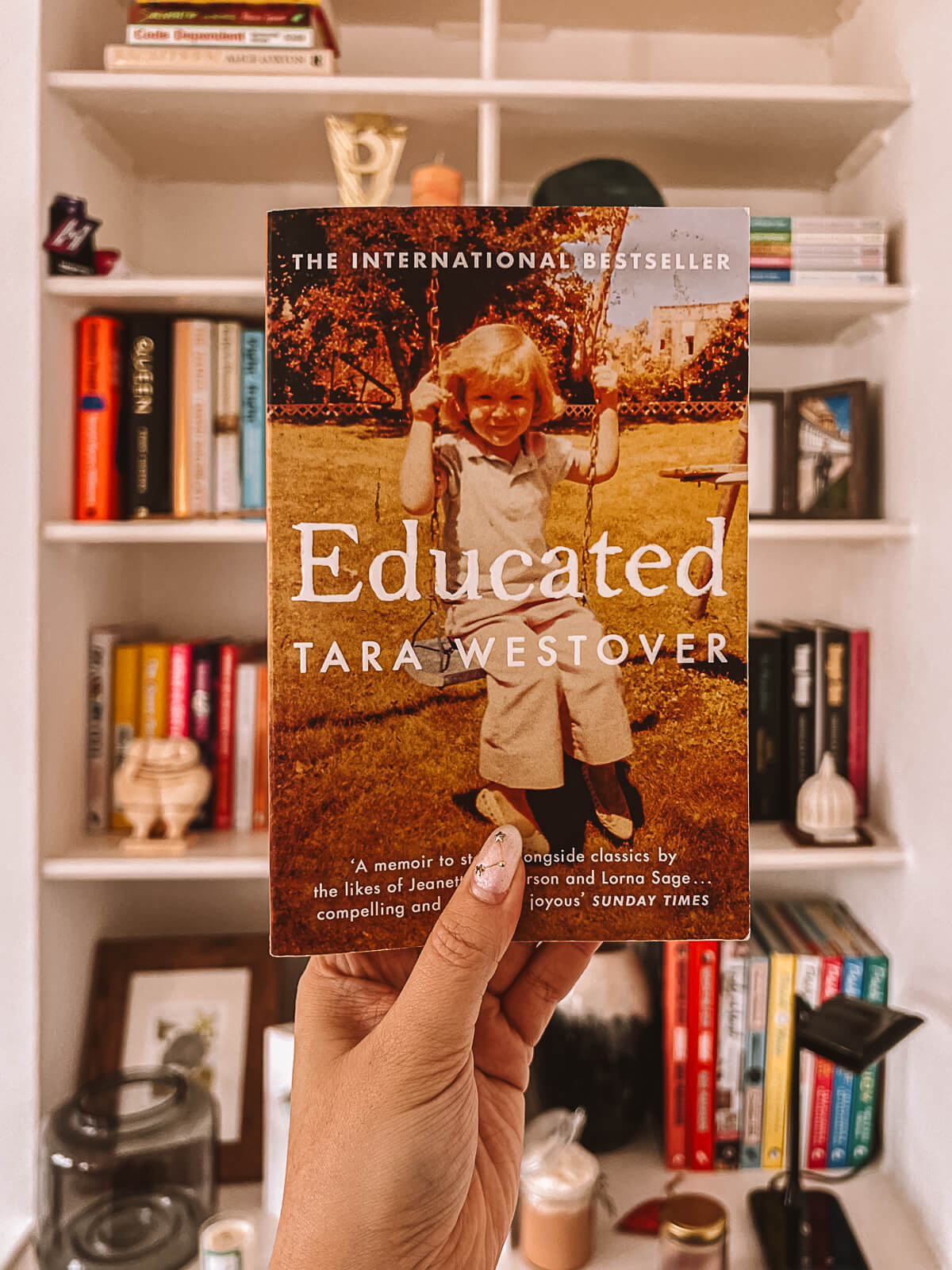
Looking for thoughtful Educated book club questions that will lead to a genuinely engaging discussion? You’re in the right place.
Educated by Tara Westover is one of those memoirs that sparks strong reactions, whether that’s frustration, admiration, or complete disbelief at what Westover experienced growing up.
It’s the incredible real-life story of Tara Westover and chronicles her unusual upbringing in a strict, survivalist Mormon family in rural Idaho, where she is denied both a formal education and access to healthcare.
As she begins to educate herself and eventually leaves home to attend university, the story becomes less about where she came from and more about the difficult process of redefining who she is.
The story is complicated and nuanced, covering religion, politics, abuse, family trauma, and difficult relationships. It’s also an uplifting tale about the power of education and the importance of new beginnings.
Having read Educated, what makes it such a powerful choice for a book club is how much it leaves open to interpretation. Readers often come away with very different perspectives on Tara’s parents, her decisions, and the role education plays in shaping identity.
That makes it ideal for a book club discussion.
In this guide, you’ll find 14 book club questions for Educated designed to help you explore the book’s key themes, including family loyalty, belief systems, abuse, and the transformative (and sometimes isolating) power of education.
If you’re reading this with a group, these questions should help you move beyond surface-level reactions and into a more thoughtful, nuanced conversation.
This guide forms part of my wider Book Club Questions series, created to support thoughtful group conversations around books. You may wish to read my book review of Educated before you dive into these questions.
14 Educated Book Club Questions
Tara is very honest in her memoir, sometimes brutally so. It gives us a great deal of information about Tara’s mindset and family relationships.
How did you feel as a reader, witnessing these intimate details about Tara’s family? Was it morally right to share these details in this situation?
The book opens with this: ‘My strongest memory is not a memory. It’s something I imagined, then came to remember as if it had happened.’ In this memory, Tara’s family shelter in the house, and a gunshot takes down her mother. Later, we find out that another family, the Weavers, are shot by federal police in similar circumstances (the incident at Ruby Ridge).
How do you think the fear of ‘the Feds’ impacted Tara and her siblings as children?
Tara’s father, Gene, is an imposing figure. He’s paranoid, and throughout Tara’s childhood, he becomes more extreme in what he dislikes (for example, he refuses to allow his children to have a public education, denies them access to healthcare, and even bans milk from the household).
Why do you think Tara’s father is so paranoid? What factors contributed to his extreme distrust of public healthcare and education?
One of Tara’s grandmothers (Grandma-down-the-hill) makes it clear that she disagrees with Gene about how he is raising his children. For example, when he decides to ban milk from the household, she jams her fridge full of milk cartons.
Do you think Tara’s grandmother helped to stop the children from being completely isolated? Do you think Tara would have ‘escaped’ without her influence?
Tara’s mother, Faye, has less extreme views than her husband. He pushes Faye into becoming a midwife, even though it terrifies her. She’s an excellent herbalist, but even she admits that medical attention is sometimes necessary (‘Herbs are supplements. For something serious, you should go to a doctor.’)
What do you think of Tara’s mother? How do you think she felt when her husband’s views became more extreme?
Religion, of course, is hugely important in the Westover family. However, Gene interprets scripture in an extreme way, and his faith becomes quite political. He believes the world will end in the year 2000 and that doctors are part of an Illuminati plot to kill innocent people. He sometimes uses scripture to back up his points.
Do you think the mixture of religion and politics is a problem? Do you think Gene’s views are becoming more common now?
Tara loved acting and singing, and she performed in a play. Despite his misgivings, Gene drives Tara to her rehearsal sessions and sits in the front row for her first performance.
What did you think about this side of Gene? Do you think it was difficult for Tara to remember the softer side of her father?
Tara befriends Charles, a boy from her theatre classes. This gives Tara a bit of normality, but it ends horribly when her brother, Shawn, begins physically abusing her. Tara gives a harrowing account of Shawn’s abuse. Unfortunately, her parents denied Tara’s account after the book was released and expressed disappointment at Tara’s allegations.
Why do you think Tara’s parents ultimately took Shawn’s side? And why do you think Shawn turned out to be so violent toward women?
Shawn’s abuse is the catalyst for Tara: encouraged by her brother Tyler, she applies for a scholarship at Brigham Young University, which aids her eventual escape. Tyler continues to help Tara throughout the book and even encourages her to complete her PhD.
What do you think would have happened to Tara without Tyler’s support and guidance?
Tara’s eventual educational achievements are incredible, especially given her patchy home-schooling experience. She has to overcome many disadvantages, including her lack of knowledge about politics, geography, and current affairs.
How do you think Tara managed to gain her qualifications? Do you think it was more difficult for her socially or educationally as she transitioned into the outside world?
Ultimately, Educated is an incredible lesson in how good education can change someone’s life. Tara’s schooling gives her a new perspective and allows her to navigate the difficulty of leaving her family and entering the real world alone.
Did this book leave you feeling grateful for your own school experience? Do you think you’ve ever taken your education for granted?
Tara’s own feelings about God are complicated. She struggles with her faith from a young age, and when she leaves home, she feels guilty and conflicted.
How do you think Tara’s education impacted her faith?
Tara tries to reconnect with her family at the end of the book. She visits home, but it doesn’t go well, and she ends up stopping contact with her parents for a year to recover from a series of panic attacks. Ultimately, she tries to reconcile with her parents, but it doesn’t go well.
What do you think about Tara’s attempts to reconcile with her family? Do you think they will ever come to have a peaceful relationship?
Tara talks about the impact her upbringing had on her mental health.
Do you think the process of writing this book was helpful for Tara? What do you see her going on to do next?
Hopefully, these book club questions for Educated will be helpful for your next discussion! It’s a fascinating, nuanced book with a lot of interesting topics to talk about and I can’t recommend it enough.
If you liked this post, check out these:
Little Fires Everywhere Book Club Questions
Where the Crawdads Sing Book Club Questions
The Vanishing Half Book Club Questions
Girl, Woman, Other Book Club Questions
The Four Winds Book Club Questions
Small Things Like These Book Club Questions
The Measure Book Club Questions