How to Find a Book to Read (Without Simply Relying on the Algorithms!)
Finding it hard to choose what to read next? Here are my tips for how to find a book to read (without simply relying on algorithms!).
The other day, one of my colleagues told me he didn’t know how to find books to read.
And I was genuinely so confused.
Not in a judgmental way, more in a wait… is that a thing? kind of way.
Because I have never had this problem. For me, the problem has always been the literal opposite.
I’ve been a book blogger and content creator for over 15 years, so I’m constantly surrounded by books.
I have an ever-growing TBR pile, I follow other book lovers online, and I make a point of visiting independent bookshops wherever I go.
I’m never short of recommendations, and, if anything, I know about far too many good books and not nearly enough time to read them all.
Bookworm problems, amirite?
But this conversation made me realise that if you’re not immersed in that world, it’s actually not that obvious how to find books that you’ll enjoy from all the millions of books out there.
Especially if you don’t want to just default to whatever is trending or sitting at the top of a bestseller list.
So if you’ve ever found yourself thinking what should I read next? or feeling like your reading list doesn’t really reflect your own taste, this post is for you.
I’m sharing exactly how I find new books, from real-life browsing to more intentional ways of discovering stories that actually suit you, so you can build a TBR that feels personal, not algorithm-driven.
Why it can be so hard to find a book to read
With millions of books out there, the sheer number of options can feel overwhelming, and it’s hard to know where to even begin.
Add in algorithm fatigue, where the same handful of trending titles are pushed at you over and over again, and it can start to feel like there’s no real choice at all.
When everything begins to look the same, finding a book that genuinely feels right for you becomes much harder than it should be.
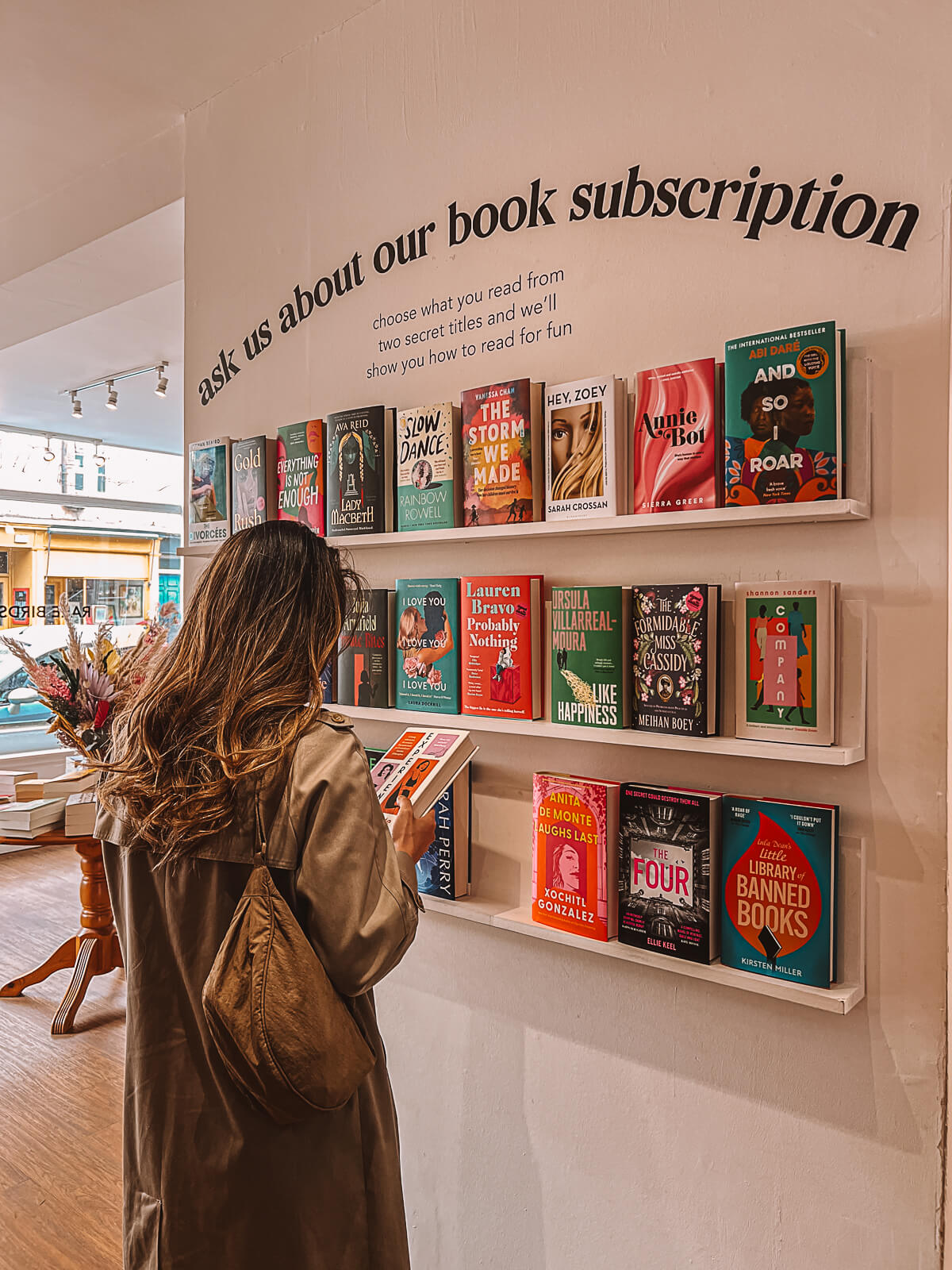
Visit your local bookshop
This might sound obvious, but it’s one of the most effective (and most overlooked) ways to find a book to read.
Go into your local bookshop without a list and give yourself time to browse properly. Pick things up, read the blurbs, see what catches your eye, and try not to immediately look up reviews for everything on Goodreads!
But, most importantly, talk to the booksellers.
The people working in independent bookshops are almost always avid readers themselves, and they’re incredibly good at matching books to people.
All good booksellers should be up for the challenge, so don’t be afraid to ask.
Tell them what you’ve enjoyed in the past, what you didn’t like, or even just the kind of mood you’re in, and see what they suggest. Some of my favourite reads have come from doing exactly this!
You’ll also often spot little handwritten recommendation cards dotted around the shop these days, too. These are staff picks, and I absolutely love them.
They’re not based on algorithms or sales data, just genuine enthusiasm for a book. It’s such a simple but brilliant way to discover something you might never have picked up otherwise.
Visit local bookshops when you travel
If you hadn’t figured it out by now, I’m an avid literary traveller, and I seek out local bookshops in every single city I visit.
I’m on a mission to discover the best bookshops all around the world, and I’m platforming them on my blog and Instagram page as I go!
This also happens to be one of my favourite ways to discover new books.
It’s similar to visiting your local bookshop, but with one key difference: you’re exposed to a completely different literary landscape.
Even if you’re browsing in English, you’ll often come across books by local authors or translations that potentially aren’t widely stocked back home.
That means you’re far more likely to stumble across writers you’ve never heard of or books that wouldn’t show up on your usual radar.
It’s also a really lovely way to engage more deeply with the place you’re visiting.
Reading a story set in that country, or written by someone from there, adds another layer to the experience and makes it feel that bit more immersive.
Use your local library
Beyond bookshops, your local library is one of the best places to discover new books, and the biggest advantage is that it’s completely free.
This means you can take risks with your reading without overthinking it. Borrow a few books that catch your eye, try them out, and if they’re not for you, you can simply return them and move on.
No guilt, no wasted money. Well, assuming you give them back on time.
Sometimes, I don’t – woops.
It’s ideal if you’re still figuring out your taste or want to experiment a bit more with what you read.
Most libraries also have dedicated displays with shelves for new releases, staff picks, or highlights within each genre, which makes browsing much easier.
And, much like in a bookshop, you don’t want to overlook the people working there. Librarians are incredibly knowledgeable and often brilliant at recommending books you might not have found on your own.

Ask for recommendations from friends and family
This one does depend slightly on having friends who read… and if you don’t, well… maybe it’s time to find some (I’m only half joking).
But in all seriousness, your friends often know you better than any algorithm ever could.
They know your personality, your sense of humour, what you tend to enjoy (and what you absolutely don’t), which makes their recommendations surprisingly accurate.
Ask them what they’ve loved recently, or if they’ve read anything they think you’d enjoy specifically.
And as a bonus, it gives you something to chat about with your friend afterwards, which is basically a built-in excuse for a coffee date.
Use Bookstagram and BookTok (intentionally)
I have slightly mixed feelings about this one (yes, even as a book content creator!).
Social media can be a great place to find book recommendations, but it can also be very trend-driven.
And if I’m honest, some of the books that go viral aren’t always… the best (in my opinion). What works for one person won’t necessarily work for you.
That said, I do think it can be useful if you approach it intentionally.
Instead of buying whatever is trending, try to find creators whose taste aligns with yours. Look at their favourite books, see if they overlap with yours, and pay attention to whether they share honest reviews, not just glowing ones.
Many creators will have introduction posts or pinned content where they talk about what they like to read, which is a great place to start.
For example, Colleen Hoover is hugely popular due to BookTok. But she really isn’t for me.
I read It Ends With Us and that was enough to know her books aren’t my thing. But plenty of people absolutely love them.
And that’s kind of the point: you need to figure out what you like, rather than assuming popular equals good.
If you like the look of what you see on my Instagram, then give me a follow, and you might discover some new books you’ll love!
Join a book club
Whether it’s in-person or online, book clubs can be a surprisingly good way to discover new books. Although I’ll admit, I was late to the party with this one.
I avoided book clubs for years, but I recently joined one at my local bookshop because I wanted to meet more people in the area.
And if I’m honest… a lot of the books we’ve read weren’t ones I particularly want to read, or, in some cases, had even heard of.
But that’s kind of the point.
Even when I didn’t love the book, I found I really enjoyed the discussions, especially when other people felt the same way.
It gave me a much clearer sense of what I don’t enjoy, which in turn helped me refine what I do like reading.
After a few months, I realised I’d naturally gravitated towards certain genres and styles. It doesn’t mean I’ll never step outside of that again, but I now have a much better understanding of what my “comfort zone” actually is, and that makes choosing my next read so much easier.
Dig into who your favourite authors read
If I see a book described as “the next Normal People” or “the next Yellowface”, I’m always a little sceptical.
Those kinds of comparisons can be interesting, but they’re often more about marketing than actual reading experience.
What I find far more useful is looking at what my favourite authors are reading and recommending.
Writers are, first and foremost, readers.
They’re influenced by other books, inspired by certain authors, and often very open about what they love in interviews, essays, or even on the covers of books themselves.
So if I see a recommendation or quote from Sally Rooney on a dust jacket, you bet I’m buying that book!
It feels like a much stronger signal than a vague comparison, because it’s rooted in genuine admiration rather than marketing spin.
Instead of just reading what’s popular now, you start to uncover the wider literary world around the authors you already love, and that’s where some of the most interesting discoveries tend to happen.
Seek out books set in (or written by authors from) places you’re travelling to
This is something I do before every trip, and it’s one of my favourite ways to discover new books.
Before visiting somewhere new, I’ll actively look for books written by authors from that country or stories set there.
For example, before travelling to Japan, I researched Japanese fiction and picked up a few novels that caught my interest. Reading them before (or during) the trip made the whole experience feel much richer and more immersive.
It’s also a great way to naturally diversify your reading. You’ll come across authors and perspectives you might never have discovered otherwise, and it often leads you down entirely new literary paths.
Look at literary prize shortlists
I have slightly mixed feelings about this one.
Just because a book has won (or been shortlisted for) a major prize doesn’t necessarily mean you’ll enjoy it.
I’ve read plenty of award-winning books that weren’t for me, and others that I absolutely loved.
That said, literary prize lists are still a really useful discovery tool.
They give you a curated snapshot of what critics and judges are paying attention to, and they often highlight books that go beyond the mainstream.
You could, for example, explore past shortlists from the Booker Prize or the Women’s Prize for Fiction and see what stands out to you.
Think of it less as a guarantee of quality and more as a way to become aware of books you might not have come across otherwise, and then decide for yourself.
If you found this post helpful, these posts may also help you on your reading journey:
How I read 75+ Books a Year
How to Read More Diversely
7 Reasons to Always Carry a Book With You
10 Things Every Book Lover Needs
How To Create a Cosy Reading Corner





I like reading but i can never stay focused long enough. Now if the book was in movie form then I could absolutely high five you there – My mum always says the book is always a lot better then the movies :D
Thanks for sharing hun
Charlotte x
Ahh that’s a shame :( Films never have quite the same level of detail in them as books but as long as they’ve captured the essence of the story, they’re awesome :D Thanks for stopping by!
Great tips! I also go by recommendations from friends and family when I’m looking for new books to read – thanks for sharing x
Recommendations from people you know are often the best as these people actually know you and what you like quite well. Friends and family should definitely be first port of call :)
I always google the best books to read! Great tips :)
http://www.beautifie.com
I find google offers me *too* much choice and I can never narrow it down!!! It’s good for finding out what’s trending at the moment though – thanks for stopping by!