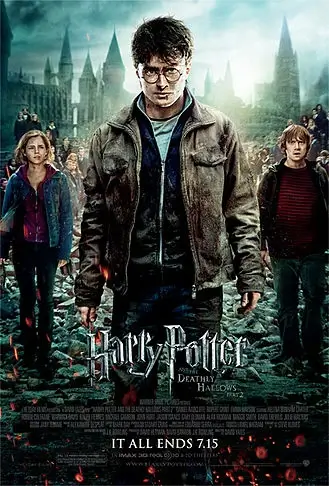
Film Review: Harry Potter And The Deathly Hallows Part 2

First, check out my review of Harry Potter and the Deathly Hallows Part 1 here.
I put off writing this review for a long time, and not because I didn’t know what to say. It was because writing about Harry Potter and the Deathly Hallows – Part 2 meant accepting that this really was the end.
Not just the end of a film series, but, not to be dramatic, but the end of a era of my life, and those of millions of other readers and viewers around the world.
I expected this final instalment to be spectacular. I don’t think anyone could have gone into it without that assumption. What I wasn’t prepared for was just how emotionally overwhelming it would be.
The scale of the battle, the intensity of the performances, and the sheer weight of everything coming to a close make this far more than a standard fantasy finale. It’s big, yes, but it’s also deeply personal.
One of the most surprising things about Part 2 is that, despite its darkness, it may well be the funniest film in the entire series.
That humour often arrives immediately after moments of grief or tension, and at times I wasn’t sure how to feel about that tonal whiplash.
I found myself crying one moment and laughing the next, which feels oddly appropriate.
Harry Potter has never been a story that exists purely in darkness; it has always made room for warmth, absurdity, and humanity, even at its bleakest points.
The emotional core of the film, for me, lies in Severus Snape. Alan Rickman’s performance is nothing short of extraordinary.
I knew this part of the story was coming, but that didn’t lessen its impact. Seeing Snape’s memories unfold on screen was one of the most quietly devastating sequences I’ve ever watched.
Rickman reveals an entirely different dimension to a character we thought we understood, and it’s handled with restraint rather than melodrama.
It was far more moving than I expected, and it completely reframed Snape’s role in the series.
There are, of course, moments fans had been waiting years to see.
Molly Weasley’s iconic line is one of them, delivered with relish, though I did feel it could have landed with slightly more force.
Ginny, meanwhile, plays a relatively small role in this film, which I had anticipated.
Still, I couldn’t help feeling that the emotional weight of her relationship with Harry never quite translates on screen.
Their connection is never fully realised, and it remains one of the weaker threads of the entire film series.
Ron and Hermione’s relationship fares slightly better, although even here the timing of their first kiss feels oddly placed.
It’s undeniably comic, and the audience reaction suggests it lands as intended, but it momentarily pulls focus from the gravity of what’s happening around them.
That said, the emotional payoff of their relationship has been so long in the making that it’s difficult not to forgive it.
Tom Felton continues to play Draco with the same uneasy blend of arrogance and fear that has defined the character throughout the series.
Draco doesn’t dominate the film, but when he appears, his internal conflict is clear.
There’s something compelling about how his confidence continues to fracture under pressure, and Felton conveys that instability well, even in brief scenes.
Much of the film’s lighter energy comes from Rupert Grint, who carries a remarkable emotional range here. Ron is funny, yes, but he’s also grieving, loyal, frightened, and brave – sometimes all at once.
Grint moves seamlessly between those states, whether he’s providing comic relief, mourning Fred, protecting Hermione, or finally stepping into his own competence.
It’s a performance that reminds you just how integral Ron has always been to the trio.
Emma Watson is consistently excellent. Hermione emerges as the emotional and moral backbone of the story, the one who keeps everything moving forward when fear threatens to stall them.
I love that this film allows her to be visibly exhausted, injured, and bloodied, yet never diminished.
She embodies intelligence, courage, and resolve, and there’s something quietly powerful about seeing that presented without apology.
Daniel Radcliffe, at the centre of it all, carries an enormous burden in this film. Harry grapples with revelations about his parents, Dumbledore, and Snape, alongside the dawning understanding of his own fate.
There are moments where Radcliffe slightly misses Harry’s internal nuance, but overall his performance captures the character’s quiet determination beautifully.
Harry’s resolve to see this through, no matter the cost, feels earned and deeply human.
Themes of loyalty, love, and friendship run through every frame of this film, but nowhere are they clearer than in Neville Longbottom’s arc. Matthew Lewis truly comes into his own here.
Neville’s transformation from a nervous, underestimated boy into someone capable of standing alone against Voldemort is one of the most satisfying journeys in the entire series.
His bravery feels organic, not performative, and it’s impossible not to root for him.
Even Voldemort himself is given an unexpected dimension. Ralph Fiennes portrays him not just as a figure of terror, but as someone increasingly desperate and exposed.
While this vulnerability differs slightly from the books, I found it effective. It makes Voldemort feel less like an abstract embodiment of evil and more like someone unraveling under the weight of his own fear.
The soundtrack deserves special mention. Music has always played a huge role in how I emotionally connect to films, and here it is used to devastating effect.
The score amplifies grief, hope, and sacrifice without ever overwhelming the scenes themselves. More than once, I found myself crying purely because of what the music was doing beneath the dialogue.
However, my one lasting disappointment lies with the epilogue. The much-hyped “19 years later” scene did not quite work for me.
The ageing effects are distracting rather than transformative, and the moment is tinged with unintended humour. I understand the need to condense the ending, but it feels oddly rushed for a story that has taken such care everywhere else.
And then, suddenly, it’s over. No more trailers, no more premieres, no more anticipation. That finality is genuinely heartbreaking.
But despite some reservations, I believe Harry Potter and the Deathly Hallows – Part 2 brings the series to a close in a way that feels earned, ambitious, and emotionally sincere.
This is not just a conclusion – it’s a farewell.
And while it may not be perfect, it honours the story, the characters, and the audience who grew up alongside them.
For that, it will always hold a special place for me.
Watch Harry Potter and the Deathly Hallows Part 2 online now
This movie ended up with 49 film award wins and a whopping 96 nominations, so I guess it resonated with others too!
If you liked this post, check out these:
Film Review: Harry Potter and the Deathly Hallows Part 1
Why the Prisoner of Azkaban is the Best in the Harry Potter Series
Harry Potter Locations in Oxford
Harry Potter Locations in London
[Updated for 2026]


I can understand why you didn't much like the ending, the audience laughed the second time I saw it in the theatres too and I didn't like who they cast for Albus Severus. (I also sort of don't REALLY like the epilogue in the book either for a couple reasons).
But one thing that the movie did which I was so grateful for was that they played Leaving Hogwarts–the same music that was used in the last scene of the first HP film. I have a massive love for the HP soundtrack (and soundtracks in general) so that really meant something to me.
(Also I realise this review is a few years old now–can't believe it's been that long!–but I found it after looking for reviews to comment for your giveaway! Haha)