Look Who’s Back Review: Why This Satirical Novel Feels Uncomfortably Relevant
Blurring the line between satire and warning, Look Who’s Back explores media culture and extremism in ways that feel alarmingly current.
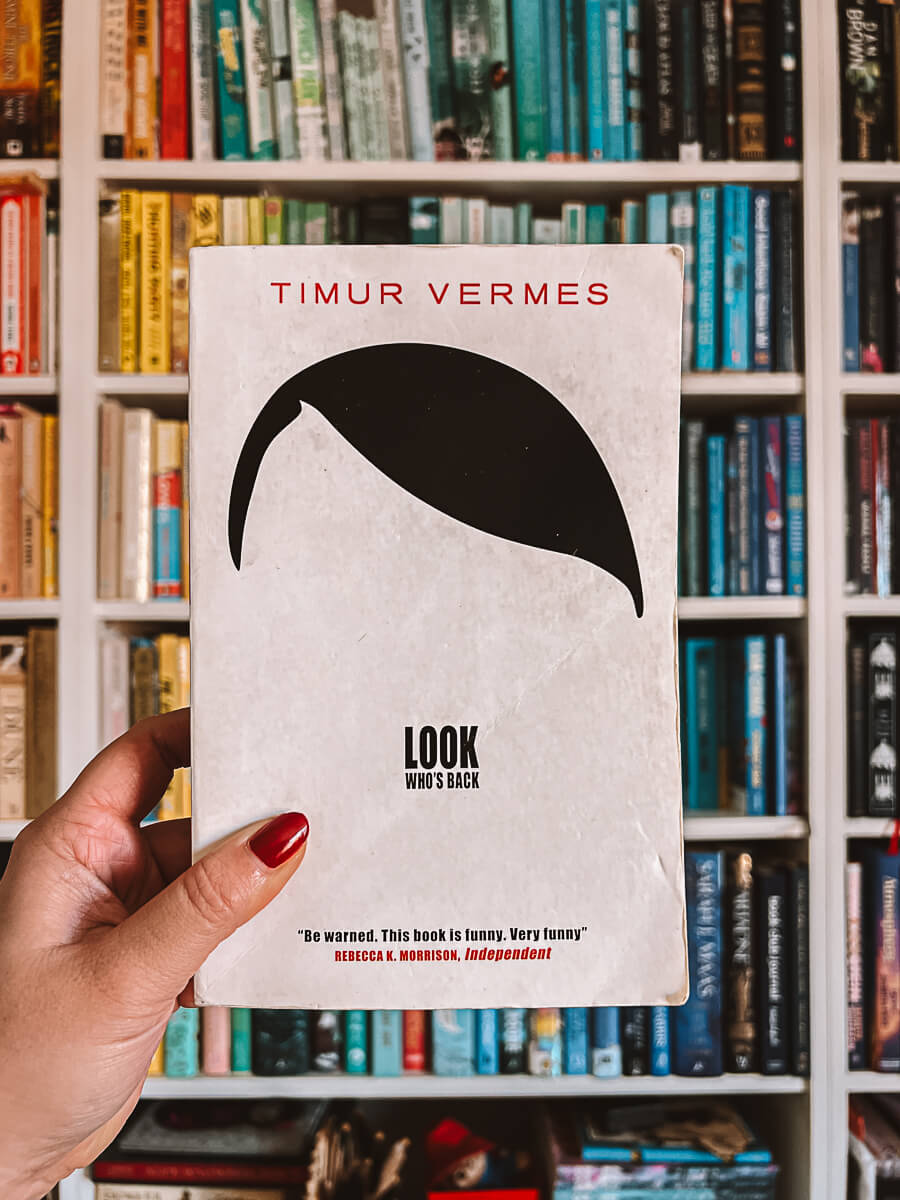
Look Who’s Back Summary
Berlin, Summer 2011. Adolf Hitler wakes up from a 66-year sleep in his subterranean Berlin bunker to find the Germany he knew entirely changed: Internet-driven media spreads ideas in minutes and fumes celebrity obsession; immigration has produced multicultural neighborhoods bringing together people of varying race, ethnicity, and religion; and the most powerful person in government is a woman.
Hitler is immediately recognized . . . as an impersonator of uncommon skill. The public assumes the fulminating leader of the Nazi party is a performer who is always in character, and soon his inevitable viral appeal begets YouTube stardom, begets television celebrity on a Turkish-born comedian’s show.
His bigoted rants are mistaken for a theatrical satire–exposing prejudice and misrepresentation–and his media success emboldens Hitler to start his own political party and set the country he finds a shambles back to rights. With daring and dark humor, Look Who’s Back skewers the absurdity and depravity of the cult of personality in modern media culture.
Look Who’s Back Book Review
Look Who’s Back opens with an unsettling premise: Adolf Hitler wakes up in modern-day Berlin, having inexplicably time-travelled from the 1940s. He has no recollection of the end of the Second World War, nor an understanding of how he ended up in modern Berlin.
All he knows is that the Germany he knew has been transformed beyond recognition. The world he encounters is dominated by social media, celebrity culture, rolling news cycles, and a public that consumes outrage as entertainment.
Almost immediately, Hitler is mistaken for a satirical performer – an impersonator who never breaks character. His extremist views are brushed off as dark humour, his bigotry reframed as commentary, and his increasingly inflammatory rhetoric interpreted as performance art.
As clips of him circulate online, he gains traction, followers, and eventually mainstream media attention. What begins as a joke slowly becomes something far more dangerous.
Timur Vermes uses satire to explore one of the most uncomfortable questions imaginable: not whether such a figure could exist again, but how easily they might be absorbed, even celebrated, by modern media culture.
What makes Look Who’s Back particularly effective is the way it exposes the mechanics of visibility and power.
Hitler does not rise because people agree with him outright, but because algorithms reward provocation, audiences reward controversy, and media platforms reward attention.
His success is driven less by ideology than by virality.
There are moments where the novel is undeniably funny. Hitler’s confusion over modern technology, advertising, and contemporary social norms offers a sharp outsider’s perspective on habits we rarely question today.
Vermes uses this device cleverly, holding up a mirror to a society obsessed with constant connectivity, celebrity, and spectacle. Some of Hitler’s observations about modern life are uncomfortably perceptive, which is precisely the point.
Humour of this kind is notoriously difficult to translate, and much credit is due to Jamie Bulloch for rendering the novel so effectively in English.
The satire lands without softening the subject matter, maintaining the tension between discomfort and laughter that runs throughout the book.
However, Look Who’s Back is not a novel driven by plot in the traditional sense. The mystery of Hitler’s return is never explained, and the narrative is more concerned with ideas than resolution.
For some readers, this will feel deliberate and thought-provoking; for others, it may feel frustratingly unfinished. Personally, I was left wanting the story to dig deeper and push further, particularly given the strength of its premise.
What makes this book especially chilling today is how relevant it feels. In light of the current political landscape (particularly in the US, but increasingly across Europe and elsewhere), the novel reads less like satire and more like a warning.
We live in a time where extreme views are often dismissed as “jokes”, and public figures gain enormous influence simply by dominating attention.
The idea that someone openly divisive could rise through irony, media manipulation, and audience complicity no longer feels exaggerated. It feels plausible, and that’s what makes this book scary.
Ultimately, Look Who’s Back does not, in my view, fully live up to the hype it received, but it remains an important and unsettling read. Its power lies not in shock twists or dramatic reveals, but in the questions it forces us to confront about media, responsibility, and how easily society can normalise the unacceptable.
Despite its flaws, this is a book that stays with you long after you’ve finished it. For readers interested in politics, history, media culture, or the darker side of satire, it is still very much worth reading – perhaps now more than ever.

Content Warning
This book centres on Adolf Hitler as a character and includes depictions of extremist ideology, racism, antisemitism, and political manipulation. These elements are presented critically and satirically, and are not endorsed, but they are explicit and intentionally provocative.
Given today’s global political climate, some readers may find the themes particularly unsettling. It’s worth approaching this book in the right headspace and being mindful of your own boundaries.
Would Look Who’s Back Make a Good Book Club Pick?
Absolutely! And, arguably, this is where the book shines most.
Look Who’s Back is ideal for book clubs because it raises far more questions than it answers. It naturally invites discussion around satire, media responsibility, free speech, populism, and the role of “irony” in excusing harmful ideas.
Different readers often walk away with very different interpretations, which makes for rich, thoughtful conversation.
It’s especially well suited to groups interested in politics, history, journalism, or contemporary culture, but even general fiction book clubs will find plenty to unpack. Just be prepared for serious discussion alongside the occasional uncomfortable laugh.
For more war stories, check out these:
Of Love and Other Wars by Sophie Hardach
Restless by William Boyd
How I Live Now by Meg Rosoff
Be Careful What You Wish For by Jeffrey Archer





Hmmm my OH actually told me about this book but i can’t stand the man so I switched off when he told me about it. Maybe I should have listened LOL. I will defo look into it. Charlotte x
I have obviously missed the hype about this book but it sounds really interesting!
Looks pretty interesting! The front cover is very artsy too.
It definitely sounds like an interesting read, I might have to check it out. x
I like the sound of that book, an interesting read for sure.
Sounds like a very interesting read